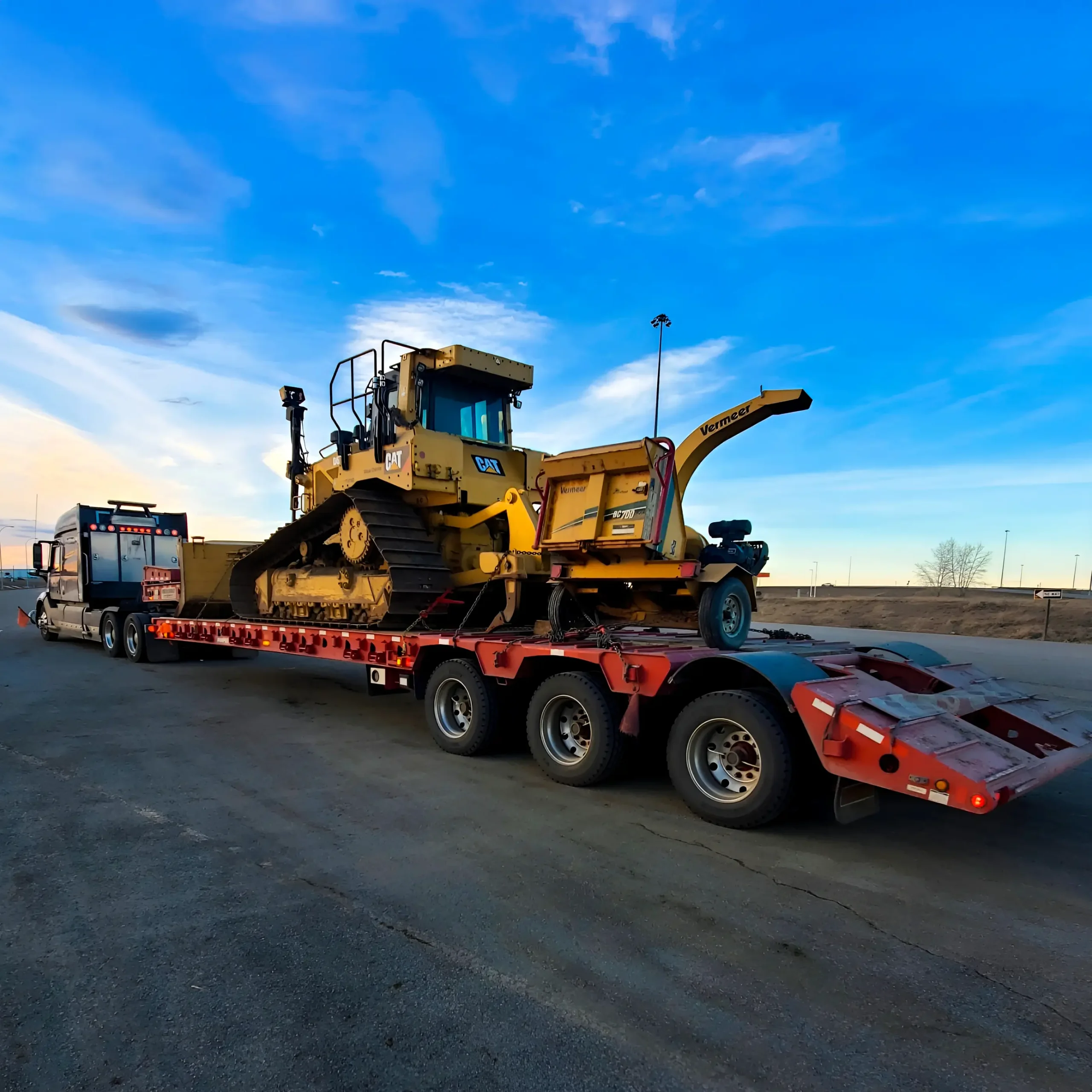
In the logistics industry, “The Last Mile” is often discussed in the context of a van delivering a parcel to a suburban doorstep. But in the Canadian Prairies—across the rolling hills of Alberta, the vast grids of Saskatchewan, and the rugged terrain of Manitoba—the “Last Mile” looks very different.
It looks like a narrow, muddy lease road. It looks like a weight-restricted bridge over a coulee. It looks like a remote oil battery or a new bin site accessible only by a section line that hasn’t seen a grader in weeks.
At Prairie Boys Hauling, we specialize in this final, most difficult stretch. Here is how we navigate the unique rural logistics of the Prairies to get your equipment exactly where it needs to be.
1. The Maneuverability Advantage: Why Big Rigs Stop Where We Start
A Class 8 semi-truck is a marvel of engineering for the Trans-Canada Highway. However, once that truck turns onto a gravel range road or a tight industrial lease site, its strengths become liabilities.
The turning radius of a 53-foot high-boy trailer is immense. On many remote sites, there simply isn’t enough “swing room” for a large tractor-trailer to navigate without driving over soft shoulders or potentially tipping into a ditch.
- The Hot Shot Edge: Our 1-ton and 2-ton power units paired with 30- to 40-foot gooseneck trailers offer a significantly tighter turning radius. We can navigate “L-shaped” lease entrances and tight oil-field batteries that would require a semi-truck to perform a 20-point turn—or worse, unhook and leave the load at the gate.
2. Respecting the RM: Navigating Weight Restrictions and Road Bans
One of the biggest hurdles in rural hauling is the patchwork of regulations set by Rural Municipalities (RMs). During the “Spring Breakup” (thaw season), RMs across the Prairies implement road bans to protect the integrity of gravel roads.
A heavy semi-truck might be restricted to 75% or even 50% axle weight, making it financially impossible or legally prohibited to move.
- Proactive Route Planning: Because our equipment has a lower “tare weight” (empty weight), we can often move loads during road bans that would ground a larger fleet. We take the lead on checking RM-specific maps and permit requirements, ensuring that your delivery doesn’t result in a hefty fine or a damaged rural road.
3. The "Soft-Tissue" Challenge: Traction in the Trenches
Prairie soil is famous for its diversity—from the “gumbo” of the Red River Valley to the sandy loams of Western Saskatchewan. When a lease site gets wet, it becomes “soft tissue” ground. A 40,000-lb tractor-trailer will sink almost instantly.
- Weight Distribution Science: Our tridem and tandem-axle trailers are designed to spread the “ground pressure” of the load. Combined with 4-wheel drive power units, we have the “float” and traction necessary to navigate a soft lease site where a standard highway tractor would simply spin its tires. We don’t just “hope” we make it; we assess the ground PSI (Pounds per Square Inch) before we pull off the gravel.
4. Section Lines and Range Roads: Beyond the GPS
If you rely solely on standard GPS or Google Maps in the deep rural Prairies, you’re going to have a bad day. Many digital maps don’t distinguish between a well-maintained gravel road and a “seasonal” road that is little more than two ruts in a field.
- Local Knowledge: We speak the language of “Legal Land Descriptions” (LSDs). Tell us the Section, Township, and Range, and we know exactly how to find it. We understand which range roads have low-hanging telecommunication wires and which bridges have “hidden” weight limits. This local intelligence saves hours of “trial and error” driving.
5. Hot Shot Delivery as a "Job Site Partner"
In rural logistics, the driver is often the only representative of the supply chain that the site foreman sees.
- Self-Unloading and Spotting: Unlike large carriers who often want to “drop and hook” or require a massive crane for every small piece, Prairie Boys drivers are experienced in “spotting” loads exactly where the crew needs them. Whether it’s backing a trailer into a tight shed or navigating between standing crops to reach a pumpjack, we treat the job site with the respect it deserves.
Bridging The Rural Gap
The “Last Mile” shouldn’t be the most stressful part of your project. By choosing a carrier that understands the geography, the RMs, and the physical limitations of the Prairie landscape, you ensure that your project stays on schedule, regardless of how remote the location is.