
In the hauling industry, there is a massive difference between a load that is “on the truck” and a load that is secured. To the uninitiated, a few ratchet straps might look like enough to get across town. But to the team at Prairie Boys Hauling, load securement is a blend of physics, legal compliance, and a professional commitment to public safety.
When you’re moving tons of equipment or materials across the unpredictable terrain of the Prairies, you aren’t just fighting gravity; you’re fighting momentum. This guide breaks down the “how” and “why” behind professional-grade securement.
1. The Physics of Momentum: Why "Tight Enough" Isn't Enough
Before a single chain is thrown, a professional hauler is calculating forces. When a truck travels at highway speeds, the cargo inside or on the trailer possesses kinetic energy. If that truck has to slam on the brakes, that energy has to go somewhere.
Forward Force: In a sudden stop, a load wants to continue forward with a force equal to roughly 0.8g (80% of its weight).
Rearward & Lateral Force: During acceleration or sharp turns, the load is subjected to 0.5g of force.
If your securement system isn’t rated to counteract these specific forces, the “securement” is merely a suggestion. We don’t just tie things down to keep them from falling off; we tie them down so they become an extension of the vehicle’s own chassis.
2. The Professional’s Toolkit: Chains vs. Straps
The most common question we get is: “When do you use the heavy chains, and when are straps better?” The answer lies in the nature of the cargo.
Synthetic Webbing (Ratchet Straps)
Straps are the workhorses of the hauling world. Made from high-strength polyester webbing, they are ideal for:
Finished Goods: Pallets, furniture, or crated equipment where metal chains would crush or mar the surface.
Flexibility: Straps have a slight “give” that allows them to absorb road vibrations without losing tension.
The WLL (Working Load Limit): Every professional strap has a tag. If that tag is missing or illegible, the strap is legally useless. We never exceed 50% of the aggregate WLL of our tie-downs.
Grade 70 Transport Chains
When the weight goes up or the cargo is “aggressive” (like raw steel, heavy machinery, or logs), we move to Grade 70 chains.
Durability: Unlike straps, chains are impervious to sharp edges that would slice through polyester.
Binding: We use ratcheting binders rather than lever binders. Why? Because a ratchet binder allows for micro-adjustments in tension and won’t “snap” back with dangerous force during release.
3. Navigating the Legal Landscape: NSC Standard 10
In Canada, we operate under the National Safety Code (NSC) Standard 10. This isn’t just a suggestion—it’s the law. Staying compliant means more than just avoiding fines; it means ensuring that if an inspection happens, the Prairie Boys fleet sets the gold standard.
| Requirement | Description |
|---|---|
| The 50% Rule | The total WLL of all tie-downs must equal at least half the weight of the cargo. |
| Minimum Tie-downs | Anything over 10 feet (3.05m) requires at least two tie-downs, regardless of weight. |
| Integrity | Tie-downs must be free of knots, frays, or cracked links. |
4. The "Art" of the Securement: Pro-Tips from the Field
Beyond the math and the law, there is the “craft” of hauling. This is what separates a DIY-er with a pickup truck from a professional hauling service.
Edge Protection: A strap is only as strong as the corner it’s wrapped around. We use plastic or rubber “bees” (edge protectors) to prevent friction from sawing through a strap during a long-haul.
The 4-Point Tie-Down: For wheeled vehicles or heavy equipment, we use four independent anchor points. This ensures that even if one chain were to fail, the load remains centered and stationary.
The “Twist” Myth: You’ll often see a single twist in a strap. This isn’t an accident—it prevents the strap from “singing” or vibrating violently in the wind, which reduces wear and tear on the webbing fibers.
Challenging Loads
The danger with round loads is the "rolling" force. We utilize timbers or chocks to create a cradle, ensuring the downward pressure of the straps or chains converts the potential rolling energy into static friction.
When hauling oversized frames or panels, wind resistance becomes a massive factor. We use cross-strapping (creating an "X" pattern) to prevent the load from "walking" side-to-side due to high-speed Prairie crosswinds.
Steel-on-steel is notoriously slippery. When securing raw steel beams or plates, we use friction mats—heavy-duty rubber layers placed between the trailer deck and the load—to increase the coefficient of friction. This reduces the reliance on the tie-downs alone to prevent sliding.
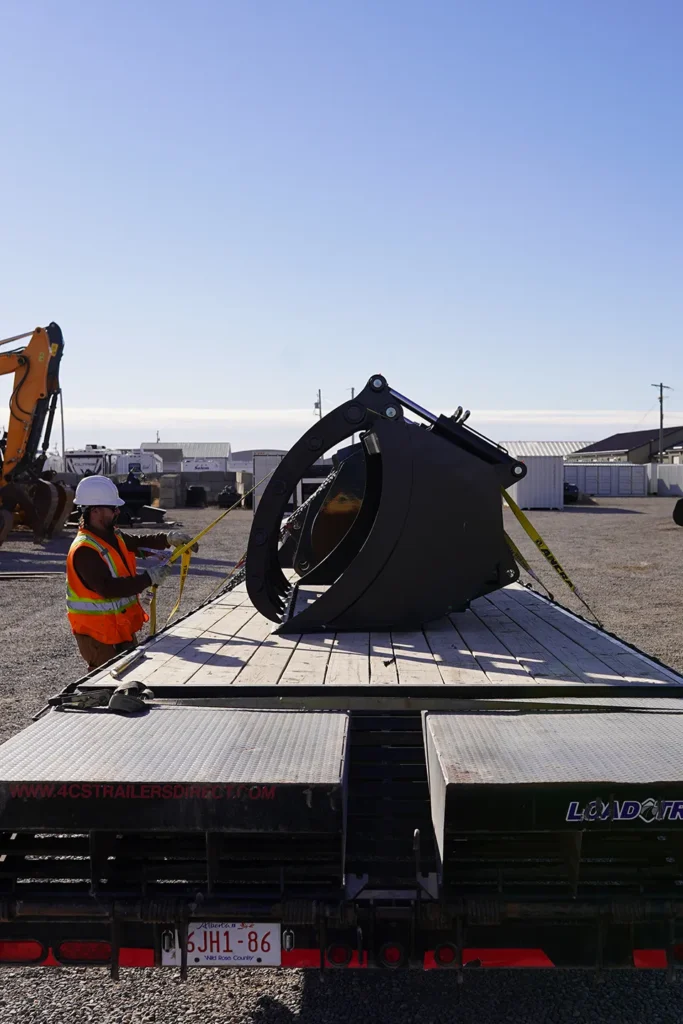
5. The Prairie Boys Inspection Routine
The job doesn’t end when the gate closes. Professional load securement is a continuous process.
The Pre-Trip: Every strap and chain is inspected for “nicks, cuts, and heat damage.”
The 80km Check: Straps settle. Loads compress. Within the first 80 kilometers (50 miles), we pull over to re-tension every binder.
The Weather Factor: Rain makes straps stretch; ice makes them slippery. We adjust our securement frequency based on what the Prairie skies are throwing at us.
Bonus: The Pro’s Guide to Calculating WLL (Working Load Limit)
Understanding WLL is the bedrock of legal and safe hauling. At Prairie Boys Hauling, we don’t guess; we calculate.
What is WLL?
The Working Load Limit is the maximum allowable force that can be applied to a piece of securement equipment (strap, chain, or d-ring) under normal operating conditions. It is usually 1/3 of the Breaking Strength of the component.
The Aggregate WLL Rule
The most critical rule in the industry is the Aggregate WLL Rule. To be legal under NSC Standard 10, the sum of the WLLs of all your tie-downs must be at least 50% of the weight of the cargo.
The Formula:
Total WLL ≥ (Weight of Cargo x 0.5)
Prairie Pro Example: > If we are hauling a piece of industrial machinery weighing 10,000 lbs, we need a total WLL of at least 5,000 lbs.
If our Grade 70 chains are rated at 3,150 lbs each, two chains (6,300 lbs total) would be the legal minimum.
However, at Prairie Boys, we often “over-secure” by adding a third or fourth chain to account for lateral movement or potential equipment failure.
The Weakest Link Principle
A securement system is only as strong as its weakest component. If you have a 10,000 lb rated chain attached to a 2,000 lb rated D-ring on the trailer, your WLL for that point is 2,000 lbs. We inspect the entire “path” of the tension to ensure there are no hidden vulnerabilities.
FAQ's
A: It depends entirely on the weight and the footprint of the load. While a 4-inch strap generally has a much higher Working Load Limit (WLL), 2-inch straps are often more versatile for securing smaller crates or oddly shaped machinery where you need to "snake" the strap through a tight gap. At Prairie Boys, we carry a variety of sizes to ensure we have the right tool for the specific geometry of your cargo.
A: You should never guess with chains. Legitimate Grade 70 transport chains are embossed with a hallmark every few links. Look for "G7" or "70" stamped directly into the metal. If the chain is plain or has no markings, it is likely a lower grade (like Grade 30 or 43) and is not legal for primary load securement on a commercial trailer.
A: If your load has a 90-degree corner, the answer is yes. Vibration during transit causes "micro-sawing." A polyester strap under thousands of pounds of tension can be severed by a relatively dull metal edge in just a few miles of highway driving. Edge protectors don’t just protect the cargo; they protect the integrity of the entire securement system.
A: This is a technical distinction in NSC Standard 10.
A Direct tie-down goes from the trailer, through/over the load, and back to the same side (or is attached directly to the load).
An Indirect tie-down goes from one side of the trailer, over the load, to the other side. The WLL is calculated differently for each. For an indirect tie-down (across the top), you generally get to count the full WLL of the strap, whereas direct attachments may only count for 50% depending on the angle. We always calculate for the "worst-case scenario" to ensure maximum safety.
A: Absolutely not. A knot in a synthetic strap can reduce its strength by upwards of 50% to 80%. It creates a stress point that will likely fail under the G-forces of a sudden stop. If a strap isn't long enough, it’s time to switch to a longer one or use a different securement method.
The Prairie Boys Promise: Securement You Can Trust
Load securement isn’t a box to be checked; it’s a professional discipline. Whether we are moving a single piece of specialized agricultural equipment or a full deck of industrial materials, our approach remains the same: Precision, Compliance, and Safety.
By understanding the physics, respecting the law, and using the highest-grade equipment, we ensure that every load we carry arrives exactly as it left—undamaged and on time. When the wind picks up across the plains and the road gets rough, you want a team that knows exactly what it takes to keep things grounded.